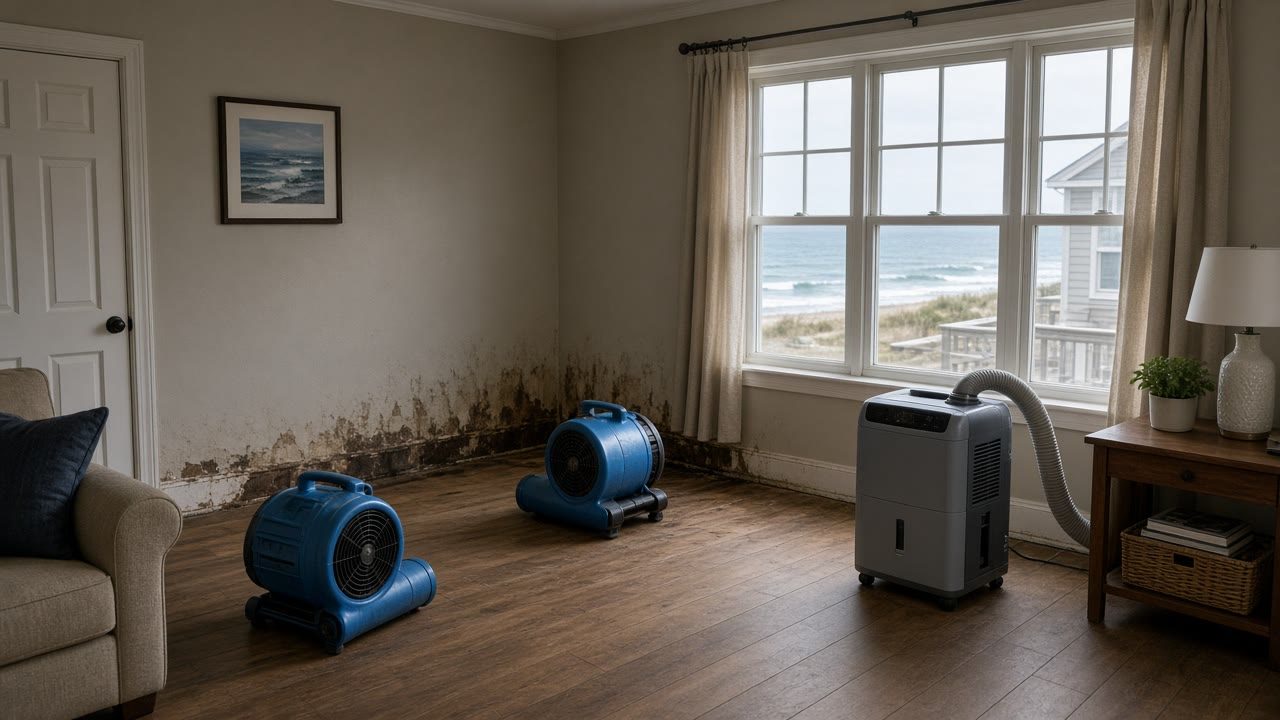
Flood Vents, Crawl Spaces, and Mold in Long Beach
How do flood vents and crawl spaces connect to mold on the barrier island?
The short answer
The openings under a raised Long Beach house let tide and rain water in and out, so the space stays damp by design. Mold then grows on what was added there, such as insulation, drywall and stored boxes.
You cannot close the vents to fix it, so the fix is to clear the space, dry it and keep it nearly empty.
What the openings under your house are for
If your Long Beach house sits on a raised floor, the enclosed space under it is built to flood. Federal rules require at least two openings in that space, totaling one square inch for every square foot of floor area, with the bottom of each no higher than a foot above the ground.
Water that can leave on its own does not push a foundation wall over. The City's code adds that each opening must be at least three inches across in every direction, and it treats a crawl space as an area that must be vented. Walk around the outside and look at your vents.
If they are blocked with boards, plastic or stored items, you have found something to fix before any mold work starts. (FEMA) (Long Beach City Code)
Why the same openings keep the space damp
Those openings let water out, but they also let air in. At Kennedy Airport, the nearest long-record weather station about nine miles west, the dew point is 60 F or higher for roughly 2,000 hours a year, and in July it stays high even at night.
A cool joist or a sheet of drywall under your floor meets that wet air for hours at a time. Add a tide that reached the space, or rain that ran in, and the moisture has nowhere quick to go.
FEMA says standing water in a crawl space can cause severe moisture damage and growth of bacteria, mold and fungus, and it recommends the space drain within 72 hours. Look for pooled water, wet soil and a musty smell, and write down what you see. (NOAA) (FEMA)

What should not be down there
FEMA lists what may not sit below the flood line in an enclosed area. That includes appliances, heating and cooling equipment, ductwork, plumbing fixtures and any material that flood will ruin.
FEMA also notes that the federal rules do not list crawl spaces as an allowed use of that space, which is why the use is limited to parking, access and low value storage. Insulation is the usual culprit.
FEMA states that insulation is not a flood resistant material, and that soaked insulation often pulls away from the joists and can drag ductwork with it. Wet insulation holds water against wood for weeks. Photograph what is in your space, then list what you could carry out and what is built in. (FEMA, 1) (FEMA, 2)
Why you cannot just close the vents
Closing the openings feels like the obvious fix. It is not allowed, and it moves the problem rather than solving it. FEMA records that a compliant enclosure can be made non compliant by what gets installed in it, and some communities have owners sign a non conversion agreement that limits the space to its allowed use.
Changing the space can also raise your flood insurance rates. Along the ocean front the City goes further and bans living in that space outright. The area has to be open or built with walls designed to give way in a storm.
Before you change anything below your floor, ask the City Building Department what applies to your address, or the Town of Hempstead if you are in Lido Beach or Point Lookout. (FEMA) (Long Beach City Code)

Send us the details
Tell us what you are seeing and which part of the building it is in. On a barrier island the room matters as much as the stain, and that is usually enough for us to say which licensed trade you actually need.
What a sensible fix looks like
Treat the space as a place that gets wet, not as a room. Take out wet insulation, carpet, drywall and stored cardboard. Let the framing and ground dry, and keep the openings clear. Put back only flood resistant material, and keep appliances and equipment above the flood line.
New York's Department of Health says the first step in any cleanup is to find and fix the source of the moisture, and to discard porous material with extensive growth. Here the source is often the space itself plus a recent tide. If heating equipment or ductwork sits down there, ask a licensed trade what moving it involves.
Then keep the space nearly empty, because less stored there means less to grow on. (NYS DOH)
When you need a licensed assessment
Many damp crawl spaces do not need a licensed assessor. New York's mold licensing rules apply to projects over ten square feet, and a residential owner working on their own property is exempt at any size. If the area is small, the material is hard and you know the cause, you may clean it yourself.
Call for an assessment when growth covers more than ten square feet, when it sits on insulation or drywall you cannot judge, or when you smell mold and cannot find it. The assessor writes the plan, a separate licensed firm removes to it, and the assessor checks the result.
Send us photos of the space and the vents, and we say which step you are on. (NY Labor Law, 1) (NY Labor Law, 2)

Read this before you call
Our guarantee
The Dry-Line Pledge
- Your request is free, and it creates no obligation.
- We charge you no fee for planning or the introduction.
- A person calls you back on the number you give.
- Inspection and removal go to two separate licensed firms.
- If an introduction does not work out, we arrange another, at no fee.
- Your $100 credit is applied exactly as our Terms say.
This pledge covers our planning and introductions. The contractor's work is covered by your contract with them. Terms.
Mold Removal Long Beach · (315) 640-3590
Start with the space, not the stain
Tell us where in the building it is and whose decision the repair is.