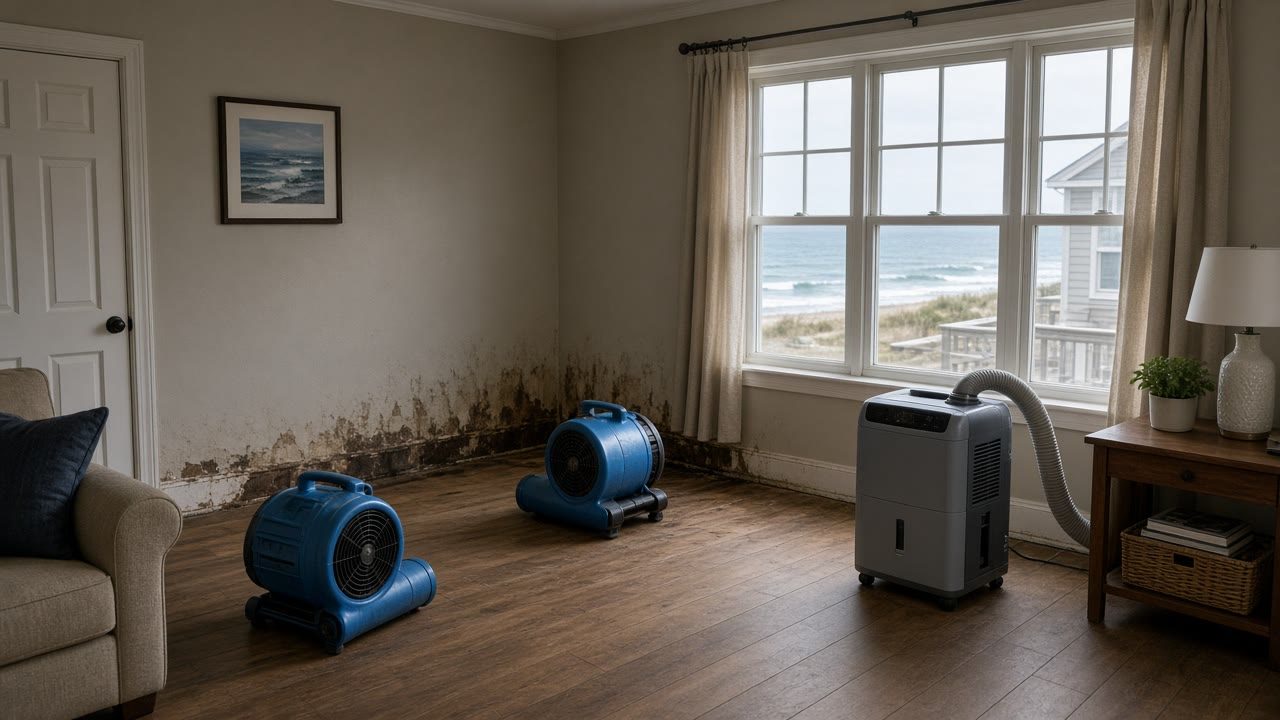
Mold After a Flood or Nor’easter in Long Beach
How soon does mold matter after coastal flooding?
The short answer
Wet drywall, carpet and insulation can start to grow mold within days, so after storm tide or flood water your first job is drying, not scrubbing. Get the water out, run air and dehumidifiers, and discard what cannot dry. Call a licensed assessor if growth covers more than about ten square feet or the smell stays after the drying.
What to do in the first 72 hours
Your clock starts when the water arrives. FEMA recommends that a crawl space drain within 72 hours, and the same logic holds for any wet room. If it is safe, shut off the source, switch off power to wet areas and get standing water out. Open windows when the weather allows, then run fans and dehumidifiers.
Photograph everything before you move it. Write down the date and time the water arrived and how high it rose. You will want that record for your insurer and for any contractor. If water is deeper than a few inches or still rising, call for a drying crew, and we can arrange one. (FEMA)
What to throw out and what to keep
New York's Department of Health says the first step in cleanup is to control the moisture and fix its source. It says porous materials with extensive growth should be discarded, naming drywall, carpet, paper and ceiling tiles. It adds that any wet material you cannot clean and dry thoroughly should go too.
Framing, block and tile can usually be cleaned and dried. Soaked insulation and carpet pad usually cannot, and FEMA notes that saturated insulation often pulls away from the joists. Bag what you remove before you carry it through the house. Keep a list with photos of what you discarded. (NYS DOH) (FEMA)

Storm tide water is not clean water
Water from the bay or the street can carry sewage and debris. That changes what you should keep, and it is one reason to bring in a crew rather than handle a soaked house alone. Sewage and contaminated water work is a separate specialty that a standard drying plan does not cover.
Wear gloves and boots, keep children and pets out of the wet area, and ask the crew before you reuse anything porous that the water touched. If you are not sure what the water was, say so when you call.
Why the flood map does not tell you if you need this
You may think a house outside the mapped flood zone is safe from this. The claims say otherwise. More than a thousand of the City of Long Beach's paid flood insurance claims since 1978 came from houses outside the special flood hazard area.
The City's Comprehensive Plan also says its high water table means flooding is a regular occurrence, with water arriving as rain, as surge from the bay and the ocean, and from the ground. If water got into your house, treat it as a flood whatever the map says. Tell us your street when you write. (Nassau County hazard plan) (Long Beach Comprehensive Plan)

Send us the details
Tell us what you are seeing and which part of the building it is in. On a barrier island the room matters as much as the stain, and that is usually enough for us to say which licensed trade you actually need.
When the job is drying, and when it has become mold
If nothing has started to grow, the job is drying, and a mold assessment is too early. Once growth appears, size sets the next step. New York's mold licensing rules apply to projects over ten square feet, and below that most homeowners can handle the cleanup themselves.
Above ten square feet, an independent licensed assessor has to write the plan before a licensed firm removes anything. The state says a signed waiver does not change that. If you see growth now, measure the patch, photograph it and send us the number. (NY Labor Law) (NYS DOL)
Check what your rebuild will trigger before you start
Once the house is dry, the rebuild has its own rules. In Long Beach you need a permit to cut away any wall or part of one, and the City says only a City licensed contractor or the homeowner can pull it.
Separately, the City treats an improvement costing fifty percent or more of the building's value as a substantial improvement, which brings the whole building up to current flood standards. The Building Department's public permit page does not mention that check, so ask about it directly. Get the answer before you sign a large interior rebuild. (Long Beach City Code) (Long Beach Building Department)

Who to call, and in what order
Match the call to what you see. Water still in the building means a drying crew first. A dry house with a musty smell means measuring the area before you decide anything. Growth over ten square feet means an assessor, then a separate removal firm, then a clearance report.
Keep your photos, your dates and your moisture readings in one folder. Call us or send the form with the room, when the water came in and what it reached, and we tell you which of the three jobs you are on.
Read this before you call
Our guarantee
The Dry-Line Pledge
- Your request is free, and it creates no obligation.
- We charge you no fee for planning or the introduction.
- A person calls you back on the number you give.
- Inspection and removal go to two separate licensed firms.
- If an introduction does not work out, we arrange another, at no fee.
- Your $100 credit is applied exactly as our Terms say.
This pledge covers our planning and introductions. The contractor's work is covered by your contract with them. Terms.
Mold Removal Long Beach · (315) 640-3590
Start with the space, not the stain
Tell us where in the building it is and whose decision the repair is.