Mold Inspection or Removal First in New York?
Should you call for mold removal or a mold inspection first in New York?
The short answer
If your wall is stained, damp or musty, the first call depends on how much there is. Growth over about ten square feet means inspection first in New York, then a separate licensed firm removes it to the inspector's written plan. Water still in the building means drying comes before both.
A small patch with a known cause may need no one.
Three situations, three first calls
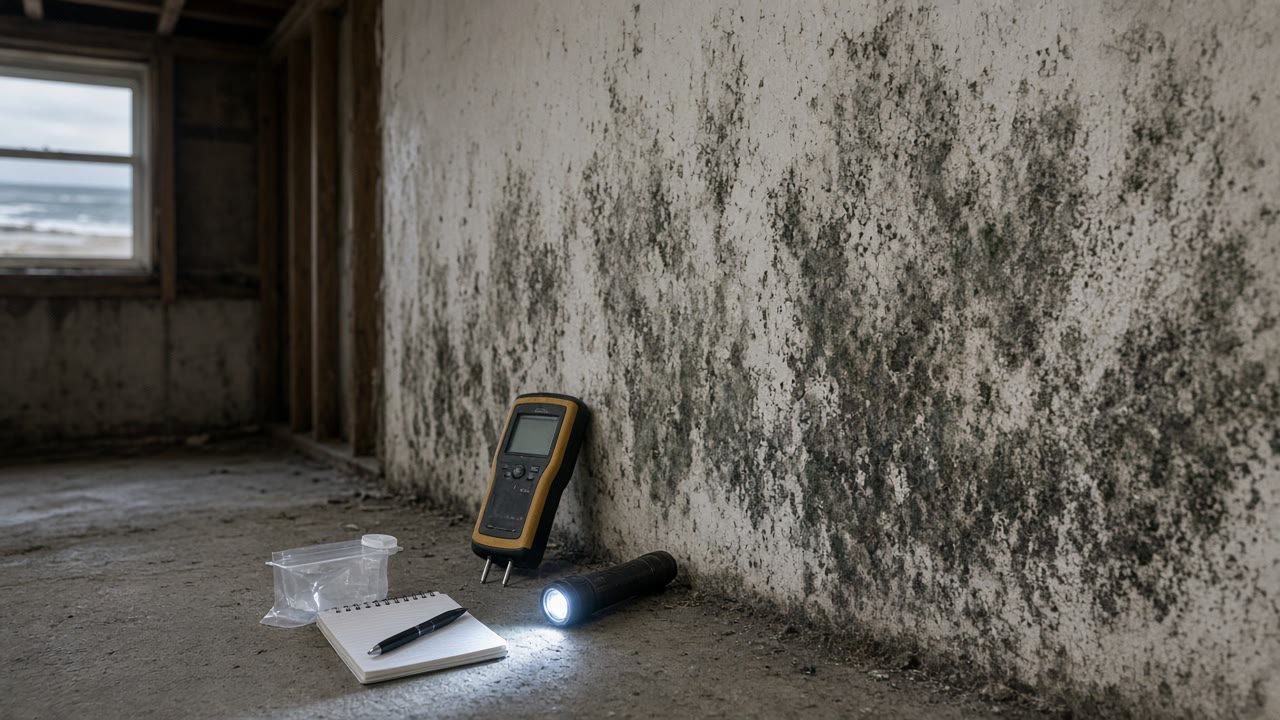
Your first call depends on what you see. If water is still in the building, call a drying crew. If you see a small patch of growth on a hard surface and know the cause, the job may be yours. If growth covers more than about ten square feet, you need an independent assessor before anyone removes it.
New York's licensing rules start at ten square feet. The EPA draws the same line for homeowners. Measure the patch, photograph it and send us the size, and we tell you which of the three you are in. (NY Labor Law) (EPA)
When drying comes before both
If the material is wet and nothing has started to grow, drying is the whole job. An assessment is too early, and removal has nothing to remove yet. FEMA says standing water can cause severe moisture damage and growth of bacteria, mold and fungus, and recommends a crawl space drain within 72 hours.
So if water came in this week, extract it, dry the structure and photograph the damage. If growth appears later, the drying record helps the assessor. Call us with the date the water arrived and what it reached. (FEMA)

Why New York keeps the two jobs apart
New York Labor Law section 936 says no licensee may do both the mold assessment and the mold remediation on the same property. It also says no one may own an interest in both the firm that assesses and the firm that removes. The assessor must give you a written report. The reasoning is practical.
The person deciding how much work is needed should not be paid by the answer. Ask any firm you hire whether it has any link to the other half of the job. (NY Labor Law)
Why a removal firm cannot skip the inspection
The State Department of Labor says the law does not allow a licensed remediator to work on a project without an assessment from a licensed assessor, even where the owner provides a waiver. It also says cost estimates for removal should not be given without an assessment.
So if someone offers to start removal today for a set price on a job over ten square feet, they are skipping a step the state requires. Ask for the assessor's plan first. If a firm will not wait for it, call someone else. (NYS DOL)

What the assessor's plan hands your removal firm
Under section 945 the assessor writes a remediation plan before work begins. It covers the rooms or areas to be worked on, the estimated quantities of material to be removed, the methods, the protective equipment, the clearance criteria, and how long and how costly the job should be.
A good plan also points to the water source and says which trade fixes it. That plan is what each removal firm prices, so you compare like with like. Ask the assessor for a copy in writing, and hand the same copy to every firm you invite to quote. (NY Labor Law)
Send us the details
Tell us what you are seeing and which part of the building it is in. On a barrier island the room matters as much as the stain, and that is usually enough for us to say which licensed trade you actually need.
Where testing fits, and where it does not
Many people assume the first step is a lab test. New York's health department advises against routine mold testing. No regulator asks for it, and homes have no official mold limit to test against. Sampling can cost more than cleaning and fixing the water problem, and knowing which mold is present does not change the advice.
A sample earns its place when you smell mold and cannot find it, or when someone else needs the condition documented. Before you pay for one, ask what the result would change. (NYS DOH)

When you may not need anyone
A residential owner working on their own property is exempt from New York's licensing requirement at any size. So you may clean your own wall, though a large job on a wet house is a lot to take on alone.
The Department of Health says porous material with extensive growth should be discarded, and that a licensed contractor should do the work where the area is greater than ten square feet. Use that as your guide. If the job is small, hard surfaced and has a known cause, clean it and fix the source.
If you are unsure, send us a photo. (NY Labor Law) (NYS DOH)
How the job closes
After removal, the assessor must confirm that the work area shows no visible mold, that the work followed the plan, and that the underlying cause has been fixed. Only then can a written passed clearance report be issued. Where the cause has not been fixed, the assessor sends a written final status report instead.
Do not let anyone take down the containment before you hold that notice. Ask the assessor for the report and keep it with your house papers. (NY Labor Law)

Read this before you call
Our guarantee
The Dry-Line Pledge
- Your request is free, and it creates no obligation.
- We charge you no fee for planning or the introduction.
- A person calls you back on the number you give.
- Inspection and removal go to two separate licensed firms.
- If an introduction does not work out, we arrange another, at no fee.
- Your $100 credit is applied exactly as our Terms say.
This pledge covers our planning and introductions. The contractor's work is covered by your contract with them. Terms.
Mold Removal Long Beach · (315) 640-3590
Start with the space, not the stain
Tell us where in the building it is and whose decision the repair is.