What Mold Work Costs on Long Island
Why is there no single price for Long Beach mold jobs, and what should you ask for?
The short answer
No honest price exists until someone has measured your job. Cost follows how much material is wet or must be thrown out, whether containment is needed, and whether drying, assessment, removal and clearance are separate line items. In New York the removal number belongs in the assessor's written plan, so ask for that first.
Why nobody can quote removal over the phone
You may have called around and heard no price, or a price that came too fast. The New York State Department of Labor says cost estimates for mold removal should not be given without an assessment, because that removes the protection of an independent assessor and a separate contractor.
The estimate of cost and time is a required part of the assessor's written plan. Treat a phone number for removal as a guess. Ask for the assessment first, then compare removal firms against that one document. (NYS DOL) (NY Labor Law)
The four line items to expect
A full job can have four parts. Drying comes first when water is still in the structure. The assessment comes next and ends in a written plan. Removal follows to that plan. A clearance check by the assessor closes the work. Not every job needs all four.
A small dry patch may need none, and a wet house with no growth may need only drying. New York does not let one licensee do both the assessment and the removal, so expect those two on separate invoices. Ask each firm which parts its price covers. (NY Labor Law, 1) (NY Labor Law, 2)

What drives the drying bill
Drying is priced by how much material is wet, how wet it is and how hard the space is to dry. A burst pipe you can shut off is a different job from a rising water table you cannot switch off. The City's own plan says its high water table makes flooding a regular occurrence.
A vented crawl space adds a twist. Federal rules require its openings to stay open, so a crew cannot seal it and dehumidify the air. The work aims at the framing, the ground and the wet material instead.
Ask the crew to record moisture readings at the start and the end, so you can see when drying finished and not just stopped. (FEMA) (Long Beach Comprehensive Plan)
What moves the removal number
Removal cost follows volume more than the size of the stain. Most of the labor is cutting out, bagging and hauling material. The Department of Health says porous material with extensive growth should be discarded, and so should wet material you cannot clean and dry thoroughly.
Under a raised Long Beach house, the volume is often insulation, drywall and stored items. FEMA states that insulation is not flood resistant and that soaked insulation can pull away and drag ductwork with it. Photograph every affected room, because more rooms and more wet material mean a bigger job. (NYS DOH) (FEMA)

Testing is the cost to question
Lab sampling is the line item people pay for without asking why. New York's health department advises against routine testing, and no regulator asks for it. It also says sampling and testing can cost more than cleaning and repairing the water problems that let mold grow.
Sampling still has a place when you smell mold and cannot find it, or when a landlord, board or buyer needs proof. Ask the assessor what a result would change before you add it to the bill. (NYS DOH)
Send us the details
Tell us what you are seeing and which part of the building it is in. On a barrier island the room matters as much as the stain, and that is usually enough for us to say which licensed trade you actually need.
What the rebuild can add
Removal leaves open walls, and putting them back is a separate cost with its own rules. In Long Beach you need a permit to cut away a wall, and only a City licensed contractor or the homeowner can obtain it. The City also counts any improvement costing fifty percent or more of the building's value as a substantial improvement.
A large rebuild could pull the whole building up to current flood standards. Ask the City about that before you agree a rebuild scope, so the number you budget is the number you pay. (Long Beach City Code) (Long Beach Building Department)

How to compare two written quotes
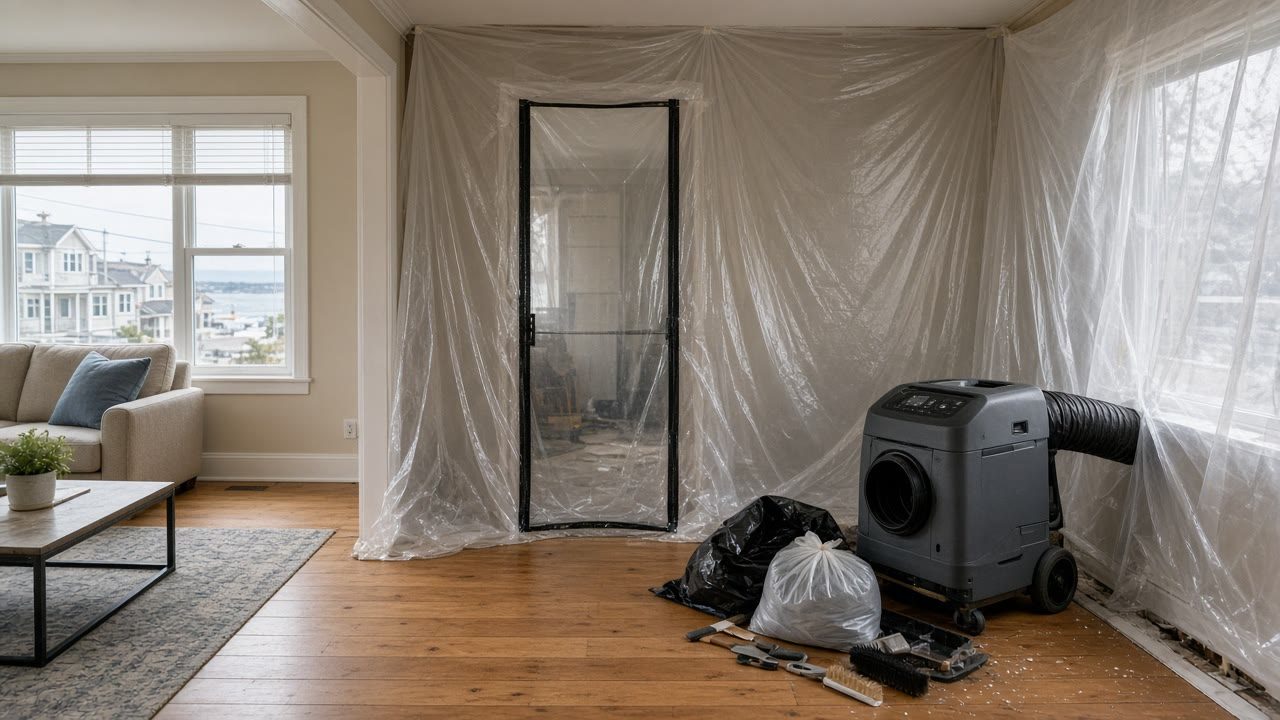
Put the quotes side by side and check that both price the same plan. Ask what is included: containment, air control, removal and disposal, cleaning, drying checks and the clearance visit. Ask what is excluded, such as the rebuild, the permit and any fix to the leak or drain that caused it.
A lower total can simply mean a smaller scope. Ask each firm to write out the rooms and quantities it priced. If the lists differ, go back to the assessor before you decide.
Where money is quietly wasted
Late drying is the first leak in the budget. FEMA says standing water can cause severe moisture damage, and material left wet becomes a larger removal job. The second is cleaning a stain without fixing the water behind it, because the stain returns. The third is refilling the space.
FEMA lists appliances, equipment, ductwork and non flood resistant materials as not allowed below the flood line. If you rebuild what the water ruined, you pay for the same job again. Decide what stays out before the work starts. (FEMA, 1) (FEMA, 2)

Read this before you call
Our guarantee
The Dry-Line Pledge
- Your request is free, and it creates no obligation.
- We charge you no fee for planning or the introduction.
- A person calls you back on the number you give.
- Inspection and removal go to two separate licensed firms.
- If an introduction does not work out, we arrange another, at no fee.
- Your $100 credit is applied exactly as our Terms say.
This pledge covers our planning and introductions. The contractor's work is covered by your contract with them. Terms.
Mold Removal Long Beach · (315) 640-3590
Start with the space, not the stain
Tell us where in the building it is and whose decision the repair is.